See our *New site*


31 August 2008

Vietnamese perspective on Mongolian Invasions

"At that time, the Mongolian became a super power in the world stage. By then, half of the world already felt into the Mongolian hands: Central Asia, Russia, Hungary, Poland, Yugoslavia, Iran... then China. After dominating China, Mongolian look into Vietnam. Then 30,000 troops of Mongolian cavalry -very well known at that time- crossed the border and attacked Vietnam the first time on January 17, 1258. Emperor TRAN THAI TONG -the one who wanted to be a Buddhist monk - now commanded the Vietnamese army to fight back. It took about 2 weeks, the Mongolian was defeated.

Angry over the defeat, the Mongolian took the revenge. The second invasion was well prepared, began on August 1284, with 200,000 strong troops under the command of a Mongolian prince. This time, the commander of Vietnamese army was Emperor TRAN NHAN TONG, also a devout Buddhist. The second invasion was not luckier than the first time. After 6 months that both sides had engaged into the fierce battles, the Mongolian was defeated and there was only a few thousands survived to back home.

For Mongolian, especially Emperor Koubilai, the defeat was so unbelievable and unbearable. It's too shameful for the Mongolian empire, therefore, only two months after the defeat, Koubilai giving the order to mobilize all of his best units, ready to take the revenge. On December 25, 1287, 500,000 Mongolian troops under the command of the same Prince, one more time, crossed the border to invade Viet Nam the third time. Again, Emperor TRAN NHAN TONG led the Vietnamese army to fight back and defeat the Mongolian. This time it took for only 4 months. Like last time, there were only few thousands Mongolian survived to comeback. After the third try, the Mongolian quitting the idea to invade Vietnam. Vietnam then began enjoying the peaceful time for about two centuries."

Labels: , , ,

24 August 2008

Mongolia Wins Second Gold Medal At Olympics


---
technorati:

Labels: , , , ,

17 July 2008

Looking Back: Mongolia State of Emergency

Mongolia MPRP Building sees mobile photo snapping  after the July 1st protestsI haven't bothered to keep track of the news here during the last weeks as there are more and more sites out there (like Mongolia Web News, News.mn and Montsame), but now as the dust settles, lets have a look at what has happened.

An overview of events is seen at OpenDemocracy:
There is an echo here of the events of January 2006 when a similar demonstration had led to forced entry into the MPRP building. Then, the same Elbegdorj had just lost his job as prime minister in a reshuffle prompted by the MPRP leadership's desire to form a new cabinet with a range of other political leaders. The MPRP was accused of hijacking democracy, and popular protests led to occupationof and serious damage to its headquarters. Elbegdorj said at the time that "there was no risk of the situation escalating into unrest" (see "Mongolia's democratic puzzle", 18 January 2006).

But this time it went haywire exploding into destructive violence. But was this still a political protest? Most believe it had turned into vandalism possibly routed in unrest but definately not in election claims. Talking about those claims. The Asia Foundation releases their report on the election producure:

In 6% of the stations, observers identified individuals seemingly trying to influence the voting behavior of others. Most of these cases occurred in the Bayanzurkh district, and involved middle-aged adults. When queried at one station, the individuals denied any involvement in voter manipulation or influence, and they did not disclose their party affiliation.

In 86% of the station visits, there was no loitering near the station by local government or party officials. However, in 18 of the station visits, party officials and candidates were observed 4 times in different stations in Khuvsgul Aimag, and in 5 discreet stations in the Bayanzurkh district.

Irregularities, indeed. But seemingly not at the scale as the opposition have claimed. Now what is the effects of all this. For some more analysis have a look at Michael Kohn's Ulan Bator Battles:

The electoral uncertainty comes at a particularly bad time. Foreign investors were excited by the prospect of a one-party majority, rather than a "unity" government, which was often mired in political infighting. The mining law, in particular, needs to be changed to ease heavy taxes -- mining companies are eager to get new projects off the ground.

Now, investors are stuck in a "wait and see" mode until the country's political strife dies down. Both Prime Minister Sanjaagiin Bayar and President Nambaryn Enkhbayar have called for calm in their respective addresses to the nation last week. But it will be Mr. Elbegdorj's moves that matter most.

Reuters provides some background on the Mining controversy that has at least amplified the unrest:
The current law gives the state either a 34 percent stake or a controlling 51 percent stake in mining projects. An investment agreement with Ivanhoe Mines (IVN.TO: Quote, Profile, Research, Stock Buzz) and Rio Tinto (RIO.L: Quote, Profile, Research, Stock Buzz)(RIO.AX: Quote, Profile, Research, Stock Buzz) for the Oyu Tolgoi project, still under negotiation, would be the first such deal.

"I don't think ownership stakes are a good idea," said Julian Dierkes, a specialist in resources and public policy at the University of British Columbia.

"I wish the government would just collect cash and throw it in postal savings. If they make 3 percent on it, they're set."


---
technorati:

Labels: , , ,

Mongolia: democracy despite emergency

OpenDemocracy.Net Reports: A violent post-election protest casts light on how Mongolia's growing social divides are creating new political strains, says Guido Verboom in Ulaanbaatar.

The events in Mongolia of 1 July 2008 - when, after an election won by the ruling Mongolia People's Revolutionary Party, demonstrations in Ulaanbaatar escalated into a wider confrontation in which at least five people died and a state of emergency was declared - have cast a shadow on the country's bright prospects. What happened, and how was it possible?

The election scheduled for 29 June 2008 was set to be an exciting and closely fought one. This young democracy has had a colourful if uneven history since Mongolia acquired full independence from Soviet tutelage at the start of the 1990s. In the 1992 elections the former communist Mongolia People's Revolutionary Party (MPRP) was rewarded for the smooth transition it had overseen by a victory in the parliamentary elections. But by 1996, people had become disappointed with the actual results of the transition period, and in overwhelming numbers voted for the opposition parties. Their record in power was equally flawed, however, and the pendulum swung back four years (and as many prime ministers) later when a reformed MPRP secured seventy-two of the parliament's seventy-six seats in the 2000 elections.

The pattern of alternating landslides was broken in 2004, when the MPRP and an opposition coalition were almost tied (with the MPRP winning thirty-nine seats). The "draw" heralded problems of a different kind, however. In parliament there was gridlock, with decision-making slow or simply impossible. This caused particular discontent at a time when Mongolia's growing social divide had made many citizens worry about their livelihood and security.

A tough transition

The biggest political issue during the post-2004 years has been mining, and the granting of rights to foreign companies to explore and produce Mongolia's rich deposits of coal, copper and gold. This raised both nationalist discontent and - as essential agreements stalled - frustration among the local and foreign business community. A bill presented to parliament in March 2008 contains the provision that at least 51% of the total capital funds in sectors where foreign companies are involved must be in Mongolian hands. Pete Morrow, departing chairman of the Business Council of Mongolia, expresses investors' hope for clarity: "While we are not political, for most foreign investors it is important that one party or the other have a clear mandate to form a government and do the people's business. Everyone has suffered from the deadlock of the last four years."

The introduction of a new voting system added to the absorbing uncertainty surrounding the 29 June election. The shift from single-member constituencies to a selection of three or four favoured candidates in larger constituencies could in principle have benefited smaller parties (as a third-placed candidate could now qualify for a seat). In reality, however, the change helped the larger parties, thanks to their greater resources and the fact that the minor parties had only one candidate.

The reform created a new challenge in the shape of the counting procedure: no more convenient piles of ballots-per-candidate, but more complicated procedures that are more prone to mistakes - and public doubts.

The 2008 campaign was relatively short, but the promotional materials were as lively as ever (one candidate distributed an entire book, accompanied by a $100 bill - with his own face replacing Benjamin Franklin's - and a roll of toilet-paper with his name printed on every sheet). The main issue was the country's increasing inequality and how the profits from mineral wealth could be distributed to alleviate it. The contract between voting and monetary incentive in the campaign was reflected in the Democratic Party's promise to people of a 1 million tugrug ($850) share in the forthcoming bonanza; the MPRP simply responded by offering 50% more.

This agenda reflects a shift in Mongolians' popular perceptions. The communist years left people with a general distrust of any state-directed system, but part of their inheritance that people valued was a sense of equal opportunities - where, for example, herder boys from remote areas could become leaders of the country. Now, the opportunity for this Mongolian equivalent of the "log-cabin-to-White- House" route seems to have diminished: politicians in their shiny four-wheel-drives are seen to care more about their own wealth than the people's poverty, and have themselves become a symbol of the economic divide rather than a means to narrow it.

The social effects of Mongolia's economic and political transformation are visible in other areas. A collapse of the educational system has resulted in a surge of commercial schools; and the media has become both money-driven and partisan, as newspapers and TV stations become the instruments of political, economical or religious groups.

A dark night

The election process itself came and went in Mongolia's by-now familiar way. The international observers praised its fairness, even though the system-changes meant that the final results were delayed. This is where the problems began. On 30 June, the MPRP starting circulating the notion that it had won an absolute majority; Tsakhia Elbegdorj, the DP leader, reacted angrily, claiming large-scale fraud by the MPRP and encouraging people to demonstrate against the election results.

The following day, 1 July, Elbegdorj and other opposition leaders disappointed by news of the election's apparent outcome and their own performance organised protests in different parts of Ulaanbaatar. The separate groups - which included followers of the Republican Party leader Jargalsaikhan, and the Civil Movement head Magnai - then assembled in the heart of the capital, before dispersing in different directions. The largest group ended up in front of the MPRP headquarters.

There is an echo here of the events of January 2006 when a similar demonstration had led to forced entry into the MPRP building. Then, the same Elbegdorj had just lost his job as prime minister in a reshuffle prompted by the MPRP leadership's desire to form a new cabinet with a range of other political leaders. The MPRP was accused of hijacking democracy, and popular protests led to occupation of and serious damage to its headquarters. Elbegdorj said at the time that "there was no risk of the situation escalating into unrest" (see "Mongolia's democratic puzzle", 18 January 2006).

On this occasion, his words were harsher and his motivation stronger. He encouraged people to come from the countryside to Ulaanbaatar and join the protest; the appeal helped to bring the crowd around the MPRP building to 8,000.

The situation deteriorates as stones are thrown and - in a replay of 2006 - protesters make their way into the building. The police, outnumbered and ineffective, retreat. When flames whoosh out from one of the windows, fire-engines arrive but the huge numbers and their hostile welcome block their advance towards the building. The protesters take full control of the commercial units on the ground floor: an airline-ticketing office, a bank branch and a duty-free liquor store. TV images show protesters creating Molotov cocktails and burning cardboard boxes.

In the end, the fire destroyed the building - and damaged the neighbouring Central Cultural Palace too. By that time the protests had turned into a violent looting orgy. Young men could be seen stealing or destroying hundreds of paintings in the palace's modern-art gallery, costumes and instruments of several orchestras, and goods in a range of other businesses in the area.

A new reality

As parliament was not in session, the president Nambar Enkhbayar used his authority to call a four-day state of emergency - the first in Mongolia's history. All private TV and radio channels were shutdown, inconveniently reminding people of the totalitarian regime that the MPRP had maintained in a previous lifetime. By 4 o'clock in the morning the crowd and fire were under control. Ulaanbaatar was waking up to a new reality. The atmosphere was tense. Soon, however, the affected area became a bit of a tourist attraction with people taking pictures with the burned-out cars. On the second day a neighbour pointed at two police officers playing badminton. "This is the state of emergency in Ulaanbaatar", he said with a grin.

Mongolia's electoral commission has announced that the MPRP had indeed won the election, but it keeps postponing release of the official results. Elbegdorj, against the odds, continues to criticise the election process, further endangering the democratic stability the country needs so much. At the same time, election worries have already faded with the preparation of Mongolia's National Nadaam Festival which begins on 11 July in Ulaanbaatar's central stadium. The archery, horse-racing, ankle-bone shooting and wrestling competitions will attract more people than any political protest.


---
technorati:

Labels: , ,

Shaman Christian Ships

We heard before about Mongolia building its own marine, although with some suspicious activities. New to me is that they have a full functioning website. There is all kind of online application procedures, and if it all works correctly, there are still some good names available including simply "mongolia".
But possibly the most unexpected tidbit is the religious statistics in the "Mongolia in Brief" section.

Religions: Buddhist Lamaist 50%, Shamanist and Christian 6%, Muslim 4%, none 40% (2004)
To have only 50% for the Buddhists is slightly uncommon, but to through Shamanist and Christian together on one pile....is unexpected, to say the least. Maybe they are believed to worship "Tenger Christ", with John the Baaptist as the spirit of the river?

Although.... Once i visited the shaman ger at the bottom of the Gandan hill. In a decor of wolf skins, Buddhist iconography and images of the young Genghis Khan. The house shaman gave a lecture on religious practise to a willing crowd, that mostly reminded me of a sermon i witnessed in a evangalical church in a backroom close to sukhbaatar square a year before. The shaman was engaging the audience with participative comments (tiim ee? tiim ee!).
So maybe the ship registry is onto something here. Would the Eagle in the TV station name, be a shamanist totem afterall?

---
technorati:

Labels: , ,

4 April 2008

The Isle of Mongolia

we know that most obscure domains come from far more obscure islands in big waters. the latest addition is intriguing. An American Domain Cow has the following on offering:

.MN is the one of newest domain name for the Internet. The .MN domain is an unrestricted and largely untapped domain name space on the Internet. Because this TLD is "new" to the market, there are Still Really Good Names Available. Great for Minnesota, Mobile Network, Music News, Main, Midnight. Get a .MN Domain Today. - .MN is the ccTLD of Isle of Mongolia.

Labels: , ,

13 May 2007

Mongolia's Ambivalant Gambling History


There has always been a lot of fuss about gambling in Mongolia. During the rule of the Democratic Party even an MP got jailed over the establishment of a casino. Later a law was passed that only gambling machines were allowed, which under Hungarian patronage resulted in every possible gambling machine being imported into Mongolia adding a lot of blinking lemons and cherries to the streets of Ulaanbaatar. Ultimately it created such a stir with people losing their complete family capital in a day that all game centers were closed down overnight.
Turning away from the electronics, there was some confusion about a horse track, followed by the invention of a free-trade zone near the Chinese border. And now again controversy has arisen over a gambling project planned close to the international Chingis Khaan airport. It has turned pretty much the some old thing with parliamentarians accusing each other of chasing after personal benefit in a recent UB Post article.
The draft faced strong opposition from L.Gundalai, chairperson of the Popular Party, who claimed that it was designed to favor a specific business interest group.
.....
But wait for the punch line:
The draft also authorizes the government to set up a special committee to control the working of casinos and other gambling businesses operating round the clock. Only non-Mongolians will be allowed to visit these gambling centers.
(italics are mine)
I think actually although not having casinos in any given country has its charms, having a limited restricted form might be a good middle way. But why in Chingis name would you not allow your own residents to visit these places? Why would you want to make a place in your country where your own people cant come? I don't think there is no economic benefit that would justify that. But hey, who am I? Probably just a potential client to some.
The final question that comes to mind is: will the ban include those very parliamentarians?

---
technorati:

Labels: , , , ,

12 May 2007

The Ultimate Google News on Mongolia

Google News To keep up to date with any news Google News seems the place to go. If your country is blessed with a customized google news (like cuba) you have it made because all news relevant for your country is automatically sorted and displayed by the big google machine. However, it seems that for Mongolia that might be some time away. Now the problem that arises from this is that you have to use search terms to actually generate some content, and that is not ideal. It means you miss out on a lot of content that IS relevant, but just doesn't feature the keyword provided. But maybe more annoying is getting articles that happen to contain the keyword but just aren't really relevant.
I am afraid there is simply isn't a cure for this ail yet, but there is a way to get a bit more relevant info instead of just typing "mongolia" in the search bar.
The first thing is that you actually want things Mongolian, which would argue for using the search term ^Mongolian^ as well. You could to that with the OR operator resulting in ^Mongolia OR Mongolian^. There is a possibility you might not want information on astronauts landing in INNER Mongolia, which can be achieved by filtering out the term ^"Inner Mongolia"^ (mind the quotes) with the [-] operator, making it all together something like:
Mongolia OR Mongolian -"Inner Mongolia"
You can add as many OR or - operators as you want like:

Mongolia OR Mongolian OR "Genghis Khan" -"Inner -Mongolia" -mining -mines
This would generate results for genghis khan, but not for items related to mining or mines. Of course it is a bit tedious to type all this in on your daily news hunt, so it might help to bookmark the page or create an email alert.


---
technorati:

Labels: , ,

29 April 2007

Empty Streets in Ulaanbaatar, Mongolia


A rather unusual site at the main vain of Mongolia's Capital: A carless Peace Avenue encouraged people to go out and stroll on the middle of the street. Even Nomin decided to turn down the volume of its giant lcd billboard opposite of the State Department Store, creating a rare peaceful atmosphere in the heart of Ulaanbaatar.
As announced in several media the carless day is an initiated by the World Health Organization to increase safety in the dense urban area. Although maybe a drawback for the local economy of shops and cafes, it might give a breathe of fresh air to the polluted city center.

Update: later in the afternoon there was a student rally and concert on Sukhbaatar Square
---
technorati:

Labels: , ,

9 March 2007

Red Roses in the Snow: Mongolia Celebrates Women's Day

There is another blogger out there in blogland with regular posts on what is so amazing about Mongolia. If i had a series like that, i would have had good one today. When I stepped out of an overpopulated State Department Store, i have to make my way through people selling red roses, people buying red roses, people looking at red roses, people carrying red roses and the rest probably already bought/sold/saw/carried their red roses earlier today.
And during this rose extravaganza, small white snow flakes were coming down from the sky while the mercury was still well subzero. Amazing.

---
technorati:

Labels: , , ,

8 March 2007

Looking Ahead: Eclipse in Mongolia

Coming out of my blogging hibernation, i get up to see: the sun is gone missing. Will is getting going to be gone missing, that is. On August 1st 2008, Mongolia will experience a total eclipse of the sun. Don Croner (no hibernation for him) has all the juicy details, including a recount of the 1997 eclipse (during which according to popular legend the reincarnation of genghis khan was born), but also a complete path of the 2008 rclipse and its path through Mongolia. And although it brings memories of Carly Simon songs to Don's head, I just can't get Bonnie Tyler out of mine.
Anyway, the really amazing bit is that a company called Sirius Travel (feel it coming?) is already offering....an eleven day tour to see the eclipse.
If you pay USD 1500 before September 2007, you can be assured to "stand in the shadow of the Moon" one year later. Well if it not so cloudy, that is.


---
technorati:

Labels: , , , , ,

2 February 2007

Chinese version of Mongolian Buddhist History

"Between 1600 and 1640, when the Great Ch’ing Empire (Daicing Gurun, Daic& ing Ulus) emerged, there were many central Tibetan priests and Tibetan Buddhist priests from Mongolia (usually called lam-a, lama,

At that time, there were large numbers of lamas in Mongolia and China, but only two of them were on the side of Ming. Both of these two lamas were invited by the Chinese military leaders in Liaotung to serve as fu k’uan. The lamas were Lama Wang (Wang lama, Sangs-rgyas Pa-sangs) and Lama Li (Lii lama, Bsod-nams Mtsho). Both of them were Chinese. Lama Wang came from the Hsuan-hua Ta-tung area and had previously engaged in negotiations with Mongolia there. His activities in Liaotung, still diplomatic work with Mongolia, were recorded from 1622 to 1629. "

Labels: , , ,

21 October 2006

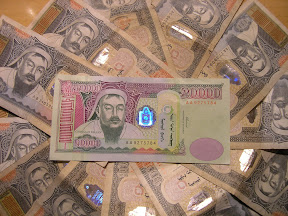
Genghis Khan Craze 132800 - Punky Chinggis on the new 20.000 banknote


The new Mongolian Tugrug note of 20,000 features a purple and green Chinggis, adding a new coulour scheme to the series of notes. The bank notes were recently launched and started circulating in the regular currency traffic. The 20,000 note now is the one with the highest value in circulation in Mongolia, with a value of around USD 17. The cover image is the same as the five hundred to ten thousand notes, but on the rear side an image of the national white banners is featured.


---
technorati:

Labels: ,

11 September 2006

Mongolia's Prince Ganjuuryn Dschero Khan

Prince Ganjuuryn Dschero Khan
Recently we received an online inquiry about Prince Ganjuuryn Dschero Khan (see image), a person of Netherlands and Taiwanese origin that was:

born officially at 28.08.1928 in Ulan Buha in the aristocracy lineage of the Bordschigin from the trunk of the Koko Mangchol in Mongolia. As one says, with blood at the hands.


This reaches the level of eccentricity of the paronoid Sheikh falcon hunter by the name of Parrot

Labels:

7 September 2006

Bad Borrower Bill Gates Reported in Mongolia

The Mongolian Bankers Association reports on "bad borrowers" in Mongolia. A slight surprise to see the name of Bill Gates pop up on top of their list. We actually tried calling his phone number listed, but - to no surprise - he didn't pay his phone bill.


=====
technorati: - -

Labels:

25 August 2006

Rare portrait of Genghis Khan discovered in north China temple


Zee News - Rare portrait of Genghis Khan discovered in north China temple: "Rare portrait of Genghis Khan discovered in north China temple
Beijing, Aug 24: A rare Thangka portrait of legendary Mongol leader Genghis Khan has been discovered in a Tibetan Buddhist temple in north China`s inner Mongolia autonomous region, a local cultural heritage official announced.

The painting was drawn by a Late Qing Dynasty (1644-1911) Mongolian artist, probably in the nineteenth century, Wang Dafang, an official with the Cultural Heritage Bureau of Inner Mongolia said.

The portrait is painted on a piece of cloth 28.5 cm long and 21 cm wide. The painting shows Genghis Khan in martial attire, riding a white horse and holding a banner in his right hand, with a bow and a quiver of arrows on his back, according to Wang.

Thangka is a Tibetan art form that dates back 1,000 years and which mainly depicts images from Tibetan Buddhism, Wang was quoted as saying by a news agency. "

Labels: ,

12 August 2006

Ulaanbaatar, Mongolia on Google Earth/Maps - Improved Satellite image


Google maps and Google earth have improved their satellite images. It gives quite an amzing view on Mongolia and especially Ulaanbaatar.
The circus seems to have been designed to see from the sky, the overcharging city taxis are waiting in front of the State Department Store, the Government palace can be clearly seen, and of course the mondriaan of ger areas.

Thanks to Robin.

----
technorati:

Labels:

15 July 2006

Genghis and the airport

While most of the world is looking with a slight bewilderment at the images and other display of Chinggis Khaan during the recent celebrations it is somehow the airport that still can bring people from miles and miles away to emotional outbursts, as in The Guardian:
"Sombre news from Ulan Bator. In honour of Mongolia's 800th anniversary, its airport has been renamed after Genghis Khan. This reflects the newly assertive stature of the former communist state. ...

[Genghis] is credited with a belief in meritocracy, decimalisation, female emancipation, freedom of religion and flat taxes (after a fashion). He also specialised in mass slaughter, razing cities to the ground (saving only the engineers and artists), and pouring molten silver into the ears of insurgent leaders or, if they preferred, suffocating them under his table while he ate dinner. Neoconservatives still often declare themselves 'well to the right' of him.

How all this will play with tourists landing at Ulan Bator airport is not clear. Genghis Khan told his generals to treat foreign foes by 'robbing them of their wealth, bathing their loved ones in tears,"

Apperently, while here it seems an innocent rename to a local hero, for some the link between the brutal Genghis Khan and an airport seems to be a hounting one.


---
technorati:

Labels: ,

18 May 2006

Learning Mongolian?

The Mongolian version of Lexicarry: Pictures for Learning Languages is now being published by Pro Lingua Inc. Lexicarry, available in multiple languages, is a picture dictionary, vocabulary builder and book of cartoon dialogues designed for the beginner to advanced language learner. The Mongolian version by Roger Cohen and Tumenjargal Budragchaa also contains an extensive section of Mongolian proverbs.

The book can be ordered online from www.lexicarry.com The Mongolian word list can now be purchased in hard copy, and will be available for free download in several weeks.
technorati:

Labels:

19 April 2006

Mongolia TV5 as online pay TV

MediaZone presents TV5:
The Mongolian TV channel TV5 is now available for online viewers through a anual subscription of about USD 100 a year. Already their news programme had the name "internet news", but it had not much to do with this ever expanding medium, as they used mostly footage that was taken from the BBC or other international channels

Labels:


Blogarama - The Blogs Directory Listed on BlogShares Travel Blogs - Blog Top Sites Subscribe with Bloglines Global Voices Online - The world is talking. Are you listening?
Mongolia Sites